AI Community Anticipates Paradigm Shift as Smaller Models Leverage Frontier Data for Advanced Performance
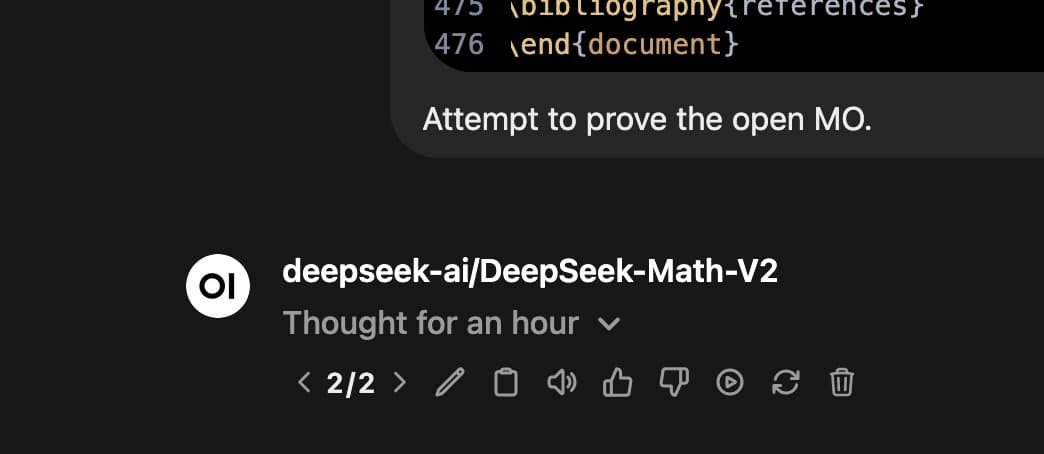
A recent social media post from a prominent AI enthusiast, Teortaxes, has sparked discussion within the artificial intelligence community regarding a potential "paradigm shift" in model development. The tweet suggests a breakthrough where smaller, state-of-the-art (SoTA) models are achieving advanced performance by leveraging high-quality data derived from larger, "frontier models" like DeepSeek-Math. This approach could signify a significant leap towards more efficient and accessible AI. Teortaxes, identified as a "DeepSeek Twitter enthusiast," articulated the sentiment, stating, > "that's underselling it, it'd be more than an achievement, it'd be a paradigm shift." The individual clarified that the development is unlikely to be a direct iteration of "Math-V2" (referring to advanced mathematical AI models), but rather a novel method of data utilization. > "I don't think it's Math-V2, that's technically implausible more like, someone leveraged a SoTA small model with a lot of good data from frontier models (like Math-V2)," the tweet elaborated. DeepSeek, a prominent AI company, has made significant strides in developing sophisticated models, including the DeepSeek-Math series. This series features open-source large language models (LLMs) like DeepSeek-Math-RL, which, despite having 7 billion parameters, has demonstrated performance on mathematical benchmarks comparable to proprietary models such as GPT-4 and surpassing many larger open-source counterparts. DeepSeek-Math's success is attributed to a two-stage training strategy involving fine-tuning on extensive mathematical corpora and reinforcement learning with a novel reward model. The concept alluded to in the tweet aligns with advanced AI techniques such as knowledge distillation and synthetic data generation. These methods involve training a smaller "student" model to mimic the behavior and insights of a larger, more complex "teacher" or "frontier" model. By leveraging the vast knowledge and reasoning capabilities of models like DeepSeek-Math, researchers can generate high-quality, targeted datasets or transfer learned representations, enabling smaller models to achieve impressive performance with significantly reduced computational requirements. This potential shift towards highly capable, yet more efficient, smaller models could democratize access to advanced AI capabilities and accelerate research into more deployable and sustainable solutions. If confirmed, such a development would represent a substantial advancement, moving beyond mere incremental improvements to fundamentally alter how high-performance AI models are developed and utilized across various applications.