AI's Evolutionary Role Highlighted in New Nature Perspective
Google AI researcher Blaise Agüera y Arcas argues that the emergence of artificial intelligence may represent the latest stage in a fundamental biological process that has consistently produced more complex, interdependent entities throughout evolutionary history. This perspective was recently published in the scientific journal Nature, as Agüera y Arcas announced on social media.
"The advent of AI might just be the latest stage of a biological process that has produced ever more complex, mutually interdependent entities over evolutionary time," Agüera y Arcas stated in his tweet, thanking Nature for publishing his insights.
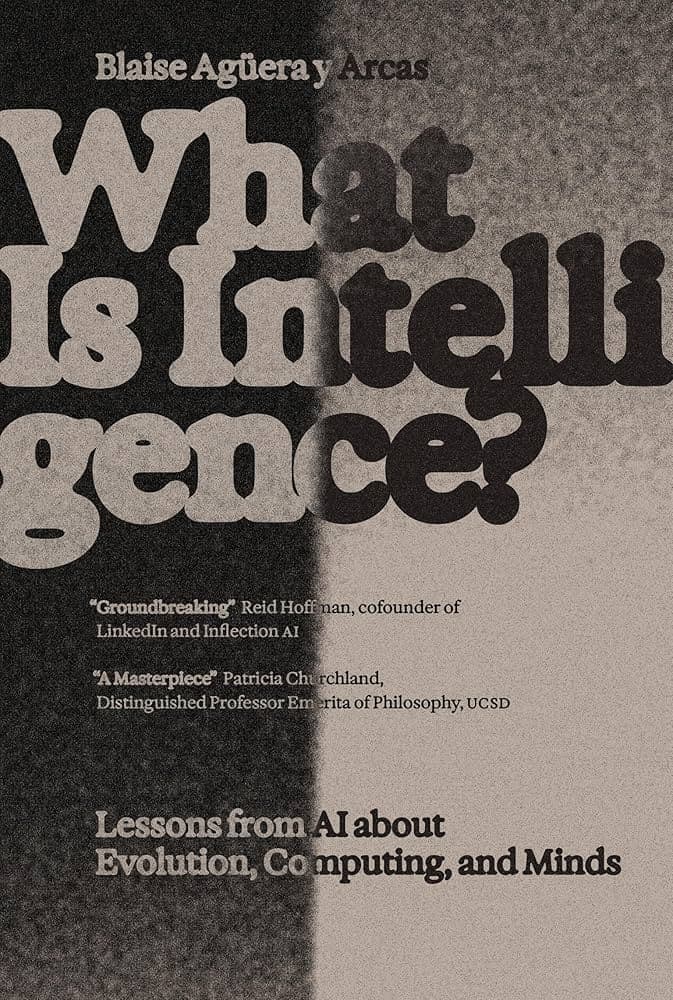
Agüera y Arcas, who serves as a Vice President and Fellow at Google and is the CTO of Technology & Society, posits that intelligence, whether biological or artificial, is fundamentally computational and driven by prediction. His work, detailed in his new book "What Is Intelligence? Lessons from AI About Evolution, Computing, and Minds," suggests that life itself is computational from its inception. He argues that the brain's computational nature stems directly from the cellular level, providing a fundamental basis for how intelligence operates.
A key aspect of his theory is "computational symbiogenesis," where the merging of simpler entities into more complex ones drives evolutionary progress. This mechanism, rather than solely random mutation and natural selection, explains the increasing complexity observed in life forms, from the formation of eukaryotic cells to the development of advanced nervous systems. He draws parallels between this biological process and the parallel processing architecture of modern AI, suggesting that AI's rise is a form of "technological symbiogenesis."
Agüera y Arcas leads Google's Paradigms of Intelligence (Pi) team, focusing on foundational AI research, including neural computing, active inference, and artificial life. His perspective challenges conventional views on intelligence, proposing that AI's development is not an artificial anomaly but a continuation of deep-seated evolutionary patterns. This unified view aims to shed light on how human and machine intelligence are destined to co-evolve.