Genie-CAT Accelerates Enzyme Design, Reducing Hypothesis Generation from Days to Minutes
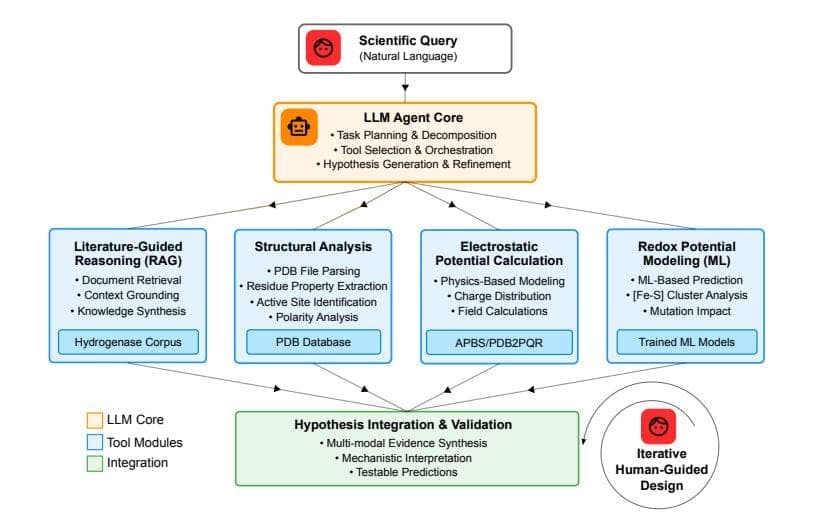
A new agentic large language model (LLM) framework, Genie-CAT, has been introduced to revolutionize enzyme design, significantly cutting down the time required for generating mechanistic, testable mutation ideas from days to minutes. Developed by researchers including Bruno Jacob, Khushbu Agarwal, and Marcel Baer from Pacific Northwest National Laboratory, the system integrates a language model with specialized tools to accurately design enzymes, particularly those with tiny metal clusters crucial for electron movement. This innovative approach promises to accelerate scientific hypothesis generation in protein design, as detailed in a recent paper titled "Beyond Protein Language Models: An Agentic LLM Framework for Mechanistic Enzyme Design" on arXiv.
Genie-CAT centers on a general language model that plans tasks, calls various scientific tools, and explains results, offering a unified workflow for complex biochemical challenges. "The paper presents Genie-CAT, which turns a language model into a practical helper for enzyme design," stated Rohan Paul on social media, highlighting the system's practical utility. This framework addresses the inherent difficulty in accurately designing enzymes with metal clusters, which are vital for electron transfer processes.
The system leverages multiple integrated capabilities to achieve its advanced design prowess. One tool searches research papers, grounding the LLM's responses in scientific literature through retrieval-augmented generation (RAG). Another tool analyzes 3D protein structures from the Protein Data Bank, identifying metal clusters and summarizing the properties of nearby amino acids.
Furthermore, Genie-CAT incorporates a physics tool to compute electric charge distributions around metal clusters, a critical factor influencing electron flow. A machine learning model then predicts how changes in this environment affect the cluster's preferred electron level, known as its redox potential. This multi-modal integration allows for a comprehensive understanding of enzyme behavior.
In a proof-of-concept demonstration using a ferredoxin test protein, a natural electron carrier, Genie-CAT successfully identified subtle environmental differences between two clusters and accurately predicted their redox strengths in the expected order. "This shows that combining language, literature, structure, physics, and prediction lets nonexperts get mechanistic, testable mutation ideas in minutes instead of days," Paul emphasized, underscoring the system's potential to empower non-experts in the field. This breakthrough signifies a new paradigm for AI-driven computational discovery, moving LLMs beyond conversational assistants into partners for scientific advancement.