Learning Outcomes and National IQ Maps Show Strong Correlation, World Bank Data Suggests
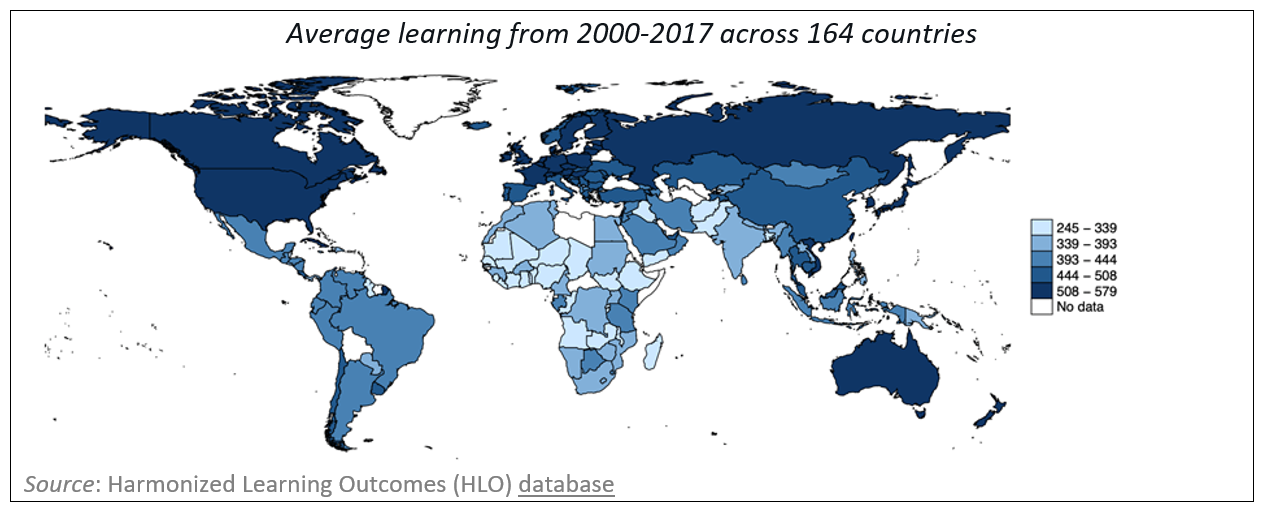
A recent social media post by user gen0m1cs has highlighted the striking similarity between national IQ maps and various educational outcome metrics, including the World Bank's "Harmonized Learning Outcomes" (HLO) and "Cliometrics of learning-adjusted years of schooling." The tweet asserted, "> If you're not a fan of national IQ maps, there are always other options and cute euphemisms we can use instead: the World Bank's 'Harmonized Learning Outcomes,' 'Cliometrics of learning-adjusted years of schooling,' and many more! The maps are basically identical." This claim is supported by academic research and data from the World Bank.The World Bank's Harmonized Learning Outcomes (HLO) database represents a significant effort to provide a globally comparable measure of education quality across 164 countries. Launched in 2018 and regularly updated, this database synthesizes results from numerous international and regional standardized achievement tests such as PISA, TIMSS, PIRLS, SACMEQ, and EGRA. The HLO scores, scaled with a mean of 500 and a standard deviation of 100, aim to offer a more direct assessment of human capital than traditional metrics like years of schooling, showing a strong association with economic growth.Research indicates a high correlation between these educational achievement metrics and national IQ scores. A 2009 study published in ScienceDirect found that national scores in reading, mathematics, and science from international tests correlated with Lynn & Vanhanen's national IQs at 0.84, or 0.935 when corrected for attenuation. This strong statistical relationship suggests that both types of measures capture similar underlying cognitive abilities at a national level.Further analysis by economists also draws direct parallels. For instance, Noah Smith noted that even when average cognitive ability is measured by the World Bank's harmonized test scores, countries in Sub-Saharan Africa often score significantly lower, aligning with patterns seen in national IQ data. One example cited a Nigerian HLO score of 262, which is approximately equivalent to 64 points on the IQ scale, illustrating the direct convertibility and consistent patterns between these different measures of cognitive performance.The World Bank's HLO database and its related metrics, such as learning-adjusted years of schooling, are designed to provide policymakers with robust data to make evidence-based decisions on human capital investment. While presented as measures of educational attainment and learning quality, their strong correlation with national IQ scores, as highlighted by the recent tweet and supporting research, underscores a consistent global landscape of cognitive and educational achievement.