Radiance Meshes Unveiled by Google and UCSD, Claiming Faster Rendering and Watertight Geometry
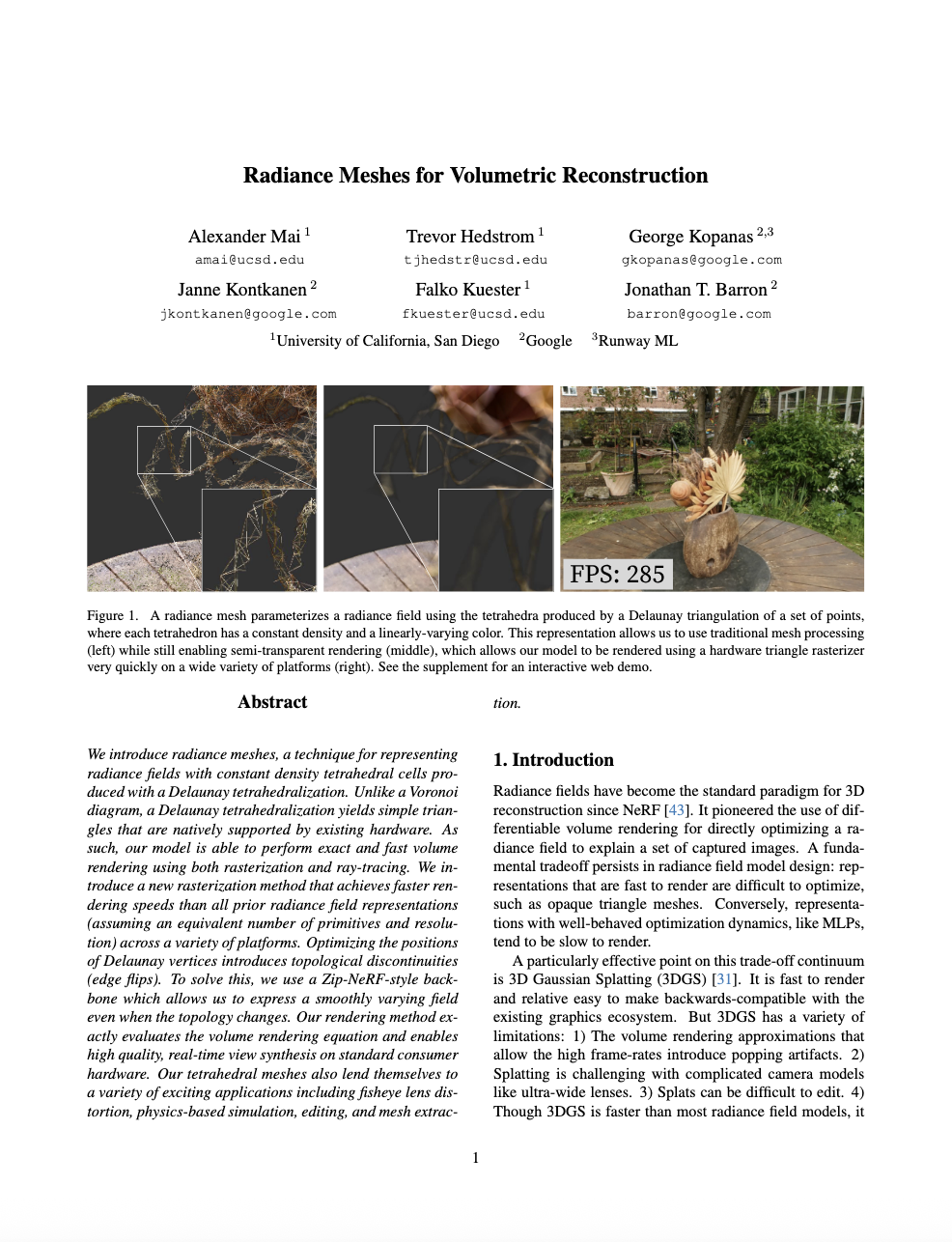
Google and the University of California San Diego (UCSD) have introduced Radiance Meshes, a novel 3D representation technology that promises significant advancements in photorealistic rendering and 3D reconstruction. This new approach reportedly combines the strengths of explicit mesh geometry with implicit radiance fields, offering a unified solution for detailed and efficient 3D content creation. The development is poised to impact various industries, from gaming and virtual reality to manufacturing and digital archiving.
The core innovation of Radiance Meshes lies in its ability to produce watertight meshes directly from multi-view images while simultaneously learning a high-fidelity radiance field. An announcement on social media highlighted the technology, stating, > "🚨Google and UCSD just introduced Radiance Meshes, a new radiance field representation that produces watertight meshes and renders faster than 3DGS. Code and demos are available now." This signifies a leap forward in generating geometrically sound 3D models with photorealistic textures.
Radiance Meshes claim to outperform existing methods like 3D Gaussian Splatting (3DGS) in rendering speed and geometric accuracy. 3DGS, introduced recently, itself represented a major breakthrough by enabling real-time rendering of complex scenes with high visual quality, significantly improving upon traditional Neural Radiance Fields (NeRFs). The assertion that Radiance Meshes renders even faster than 3DGS points to a substantial performance enhancement for real-time applications.
The capability to produce "watertight meshes" is particularly critical for numerous applications. Watertight meshes are completely enclosed 3D models without any holes or gaps, which are essential for processes like 3D printing, simulations, and finite element analysis. These applications require a precise definition of an object's volume and surface, making the inherent watertight nature of Radiance Meshes a significant advantage over methods that primarily focus on visual fidelity.
The collaborative research between Google and UCSD, two prominent entities in advanced computer graphics and AI research, underscores the academic and industrial interest in pushing the boundaries of 3D technology. The immediate availability of code and demos, as mentioned in the tweet, suggests a commitment to fostering further research and broader adoption within the developer community. This new representation holds the potential to streamline workflows in digital content creation and improve the fidelity of virtual experiences.