ThetaEvolve's 8B Model Achieves New Mathematical Bounds, Outperforming Larger Systems
A new open-source framework, ThetaEvolve, has demonstrated a significant leap in artificial intelligence's capability for mathematical discovery, enabling a single 8-billion-parameter model to surpass the performance of larger, closed-source systems on complex open problems. The framework, detailed in a paper titled "ThetaEvolve: Test-time Learning on Open Problems" by Yiping Wang, Shao-Rong Su, and their collaborators, achieves state-of-the-art results in areas like circle packing and autocorrelation inequalities. This development highlights the potential for smaller, open-source models to contribute to advanced scientific findings.
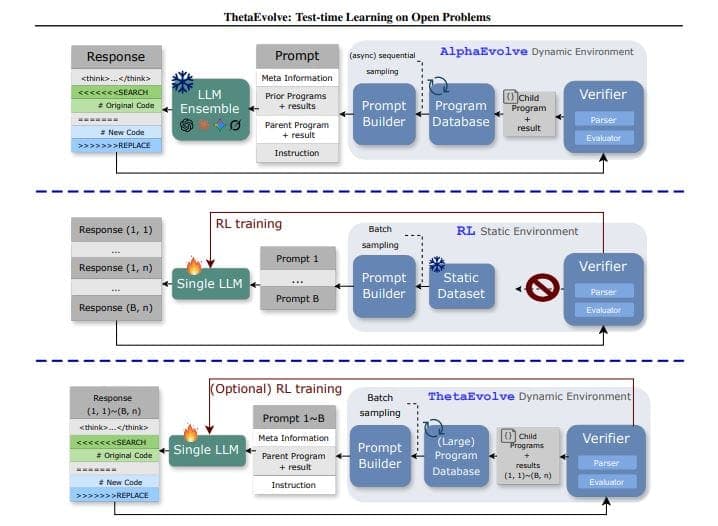
The core innovation of ThetaEvolve lies in its ability to combine in-context learning with test-time reinforcement learning (RL) updates, allowing the model to continuously refine its problem-solving strategies. The researchers stated in their paper that ThetaEvolve "simplifies and extends AlphaEvolve to efficiently scale both in-context learning and Reinforcement Learning (RL) at test time, allowing models to continually learn from their experiences in improving open optimization problems." This approach contrasts with earlier systems like AlphaEvolve, which relied on ensembles of large, closed models and did not update the model itself.
Specifically, ThetaEvolve, utilizing the DeepSeek-R1-0528-Qwen3-8B model, achieved a circle packing density of 2.63598308, marginally exceeding AlphaEvolve's 2.63586276. This improvement, though numerically small, represents a new best-known bound in a notoriously difficult optimization problem. The framework's efficiency is notable, with its program finding the best-known solution for circle packing in approximately three seconds, significantly faster than other advanced systems.
The methodology behind ThetaEvolve involves a simplified setup with a single large language model, a large program database for enhanced exploration, and batch sampling for increased throughput. It also incorporates "lazy penalties" to discourage unproductive outputs and optional reward shaping to stabilize RL training. According to the research, "For each step, it samples several parent programs, builds prompts that show their code and scores, and asks the model to write improved child versions." A separate verifier then evaluates these programs, adding successful ones back to the database and penalizing ineffective attempts.
This open-source release is poised to lower the barrier for academic and industry teams to engage in automated theorem proving and combinatorial optimization. The research indicates that RL-trained checkpoints not only excel on trained tasks but also generalize to new, unseen problems, suggesting a broader applicability for the learned evolutionary capabilities. The authors of the paper are affiliated with institutions including the University of Washington, Microsoft, and Amazon, underscoring the collaborative nature of this advanced AI research.