S&P 500's Top 10 Sees 100% Turnover in Four Decades, Highlighting Market Evolution
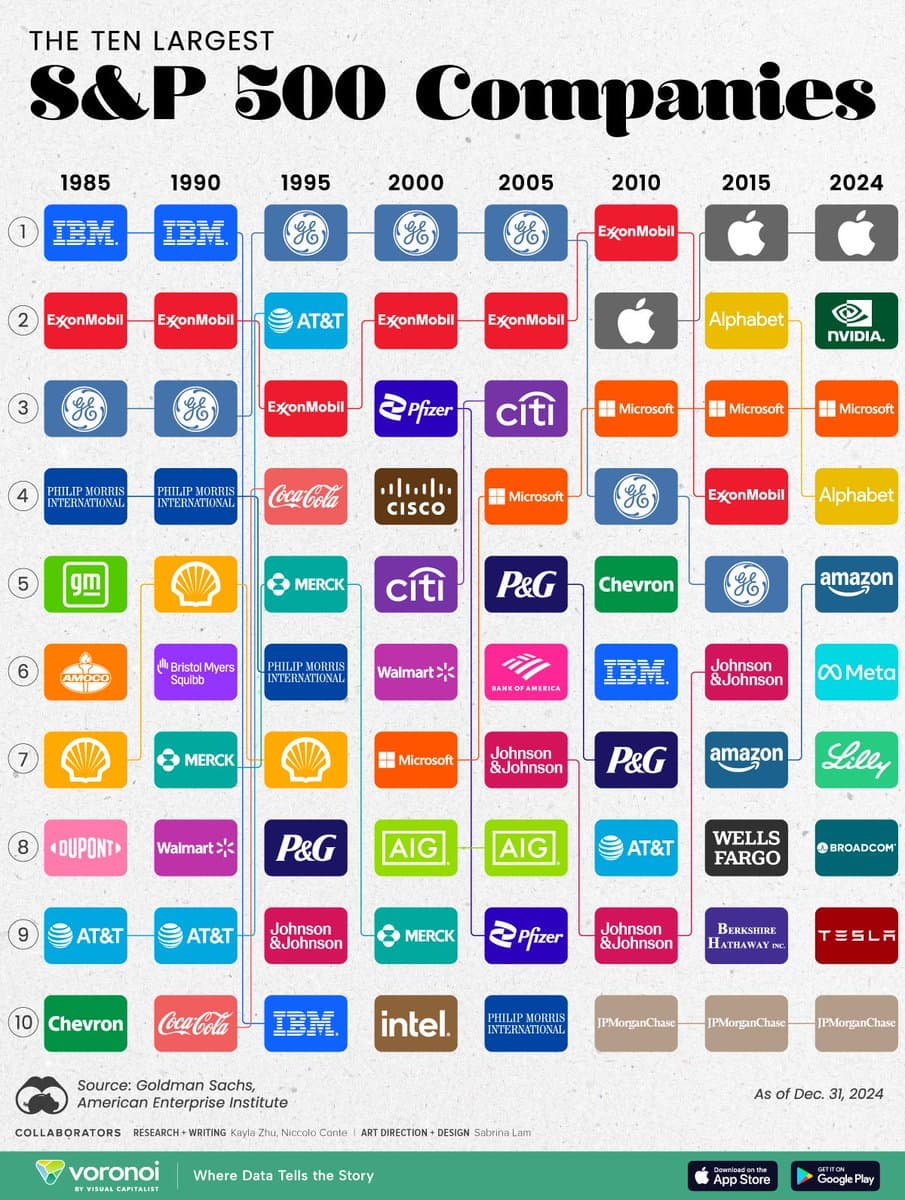
A recent observation from Meb Faber, Chief Investment Officer of Cambria Investment Management, underscores a dramatic shift in market leadership, revealing that none of the largest 10 companies in the S&P 500 Index from 1985 remain in the top 10 today. This complete turnover highlights the relentless forces of innovation, economic cycles, and corporate evolution that reshape the American corporate landscape over time.
"Of the largest 10 stocks in the S&P 500 Index in 1985, none are still in the top 10," Faber stated, drawing attention to the dynamic nature of market dominance. This assertion is supported by historical data, which shows a stark contrast between the market leaders of the past and the present. In 1990, for instance, the top companies included industrial giants like IBM, General Electric, and Exxon Mobil, alongside consumer staples such as Philip Morris and Coca-Cola.
Today, the S&P 500's top echelon is overwhelmingly dominated by technology and innovation-driven firms. As of 2024, companies like Apple, Nvidia, Microsoft, Alphabet, and Amazon command the highest market capitalizations. This transition reflects a profound shift from an economy once powered by manufacturing, energy, and consumer goods to one increasingly driven by digital technologies, software, and advanced computing.
Meb Faber, a respected author and proponent of systematic investment strategies and global diversification, frequently emphasizes the importance of understanding long-term market trends. His work consistently points to the cyclical nature of market leadership and the perils of concentrating investments in a narrow set of companies or sectors. The disappearance of 1985's giants from the top ranks serves as a powerful illustration of these principles.
The significant turnover also underscores the challenges of maintaining long-term competitive advantage. Companies that once held unassailable positions have either been outpaced by newer, more agile innovators, or their industries have simply become less central to the broader economy. This continuous churn is a hallmark of a vibrant, albeit unforgiving, capitalist system, consistently rewarding adaptability and disruptive innovation.