Tom Stoppard's Arcadia Credited with Inspiring Life-Saving Breast Cancer Treatment
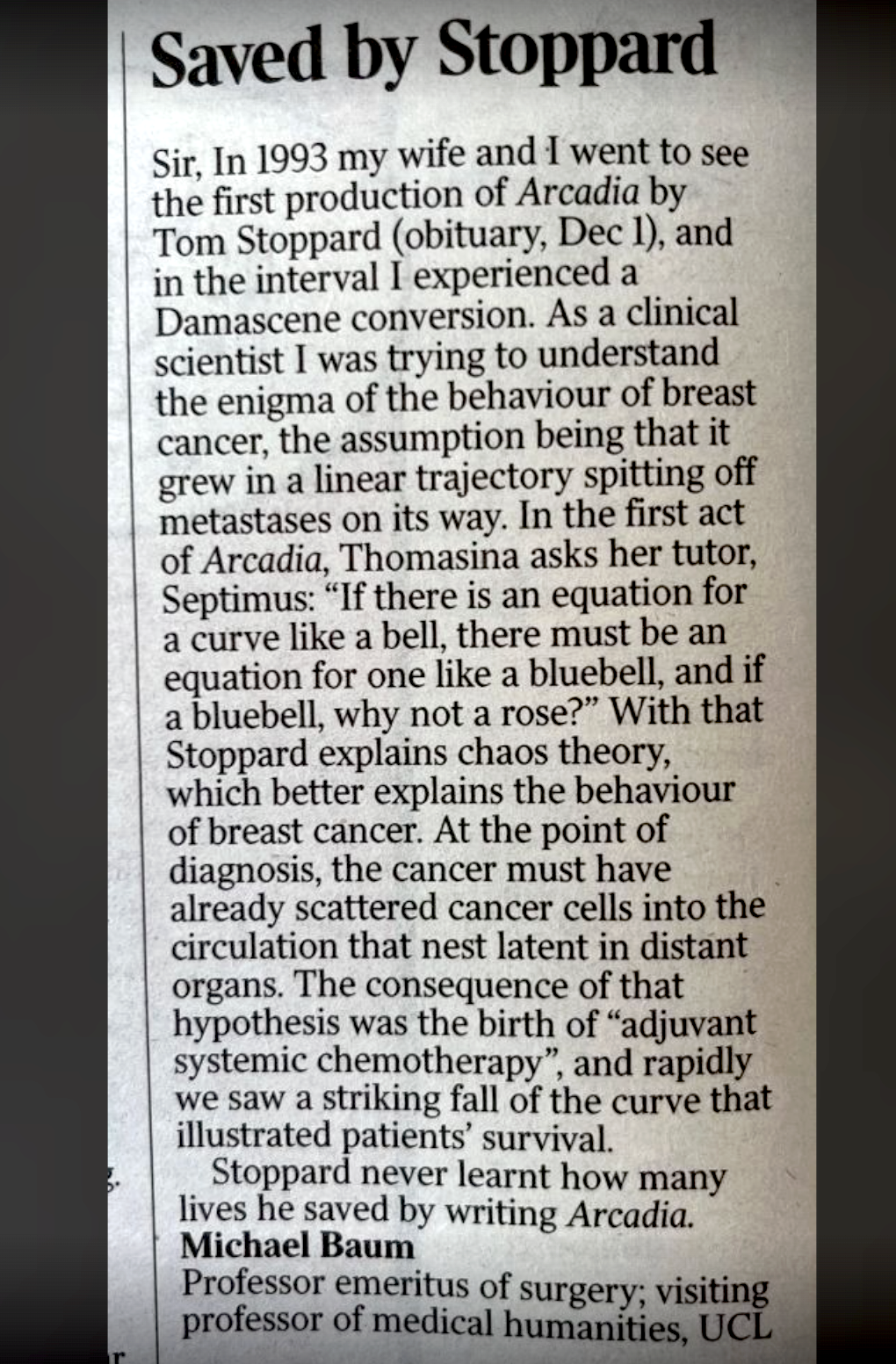
A letter published in The Times by Professor Michael Baum, emeritus of surgery at University College London, has highlighted how playwright Sir Tom Stoppard's work, specifically his play Arcadia, directly influenced a medical breakthrough in breast cancer treatment. The revelation comes amidst widespread tributes following Stoppard's recent passing at the age of 88. Harry Wallop, a journalist, shared the letter on social media, emphasizing that "Great culture can save lives. Literally."
Professor Baum recounted a "Damascene conversion" he experienced in 1993 during the interval of Arcadia's first production. At the time, he was grappling with the enigma of breast cancer behavior, which was then assumed to follow a linear growth trajectory. He found inspiration in a line from the play where the character Thomasina asks her tutor, Septimus: "If there is an equation for a curve like a bell, there must be an equation for one like a bluebell, and if a bluebell, why not a rose?"
This philosophical inquiry, used by Stoppard to explain chaos theory within the play, provided Professor Baum with a new lens to understand breast cancer. He realized that chaos theory offered a better explanation for the disease's behavior, suggesting that cancer cells might scatter into circulation and nest latently in distant organs even at diagnosis. This hypothesis led to the development of "adjuvant systemic chemotherapy," a treatment that has since resulted in a striking fall in patient mortality rates.
Sir Tom Stoppard, born Tomáš Sträussler in Czechoslovakia, was a celebrated playwright known for his intellectually stimulating and witty works. His career spanned decades, earning him numerous accolades, including four Tony Awards for Best Play. His plays often explored complex ideas, history, and philosophy, demonstrating the profound and unexpected ways art can intersect with and influence scientific understanding and real-world outcomes. Professor Baum noted that Stoppard "never learnt how many lives he saved by writing Arcadia," underscoring the quiet yet monumental impact of his artistic vision.