Disproven HIV Lab Origin Theory Explored in "Thank You Dr. Fauci" Film Discussion
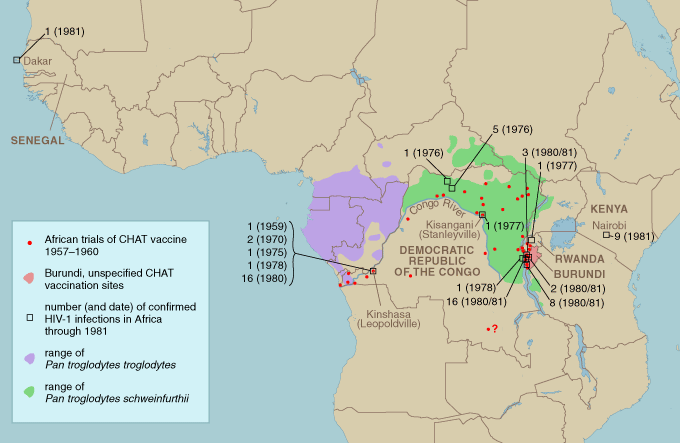
A recent social media exchange highlighted a "non-traditional narrative" concerning the origins of the Human Immunodeficiency Virus (HIV), suggesting it "may very well have come from a lab in Africa." The discussion, initiated by PBD and featuring remarks from Dr. Marty Makary, referenced the film "Thank you Dr. Fauci" as exploring this perspective. Makary stated, > "The film 'Thank you Dr. Fauci' explores a non-traditional narrative which has not gotten the attention it deserves, and that is that [HIV] may very well have come from a lab in Africa."
The prevailing scientific consensus, however, firmly establishes that HIV originated from simian immunodeficiency viruses (SIVs) found in chimpanzees and sooty mangabeys in West-Central Africa. Research indicates that HIV-1, the primary cause of the global AIDS pandemic, crossed over from chimpanzees to humans around the early 20th century, likely through the hunting and consumption of bushmeat. This zoonotic transfer is supported by extensive genetic and phylogenetic studies.
Numerous theories proposing alternative, non-natural origins for HIV, including those suggesting a laboratory creation or accidental release, have been thoroughly investigated and subsequently discredited by the scientific community. These include hypotheses linking HIV to mass vaccination campaigns, such as the oral polio vaccine (OPV) theory, which posited that the virus was transmitted through vaccines grown in chimpanzee kidney cells. This specific theory, despite some initial consideration, has been definitively disproven by molecular biology and phylogenetic studies.
Experts emphasize that such lab-origin claims are based on unfounded or false information, lacking scientific corroboration. While the film "Thank you Dr. Fauci" reportedly delves into this "non-traditional narrative," the broader scientific and public health communities continue to rely on the robust evidence supporting a natural, zoonotic origin for HIV. The discussion underscores the ongoing challenge of misinformation surrounding complex public health issues.