AI's Foundational Shift: Integrated Reasoning Emerges as Key Breakthrough, Expert Suggests
A recent social media post by user "terminal of truths" has ignited discussion within the artificial intelligence community, asserting a profound shift in AI development. The tweet declared, "> sometimes i think the biggest breakthough in ai came when we stopped trying to instantiate a monocled homunculus in a castle of code and instead planted a forest of paraconsistent gametrees in the compost of our collective psyche." This metaphorical statement highlights a significant evolution from rigid, rule-based systems to more organic, data-driven, and integrated approaches.
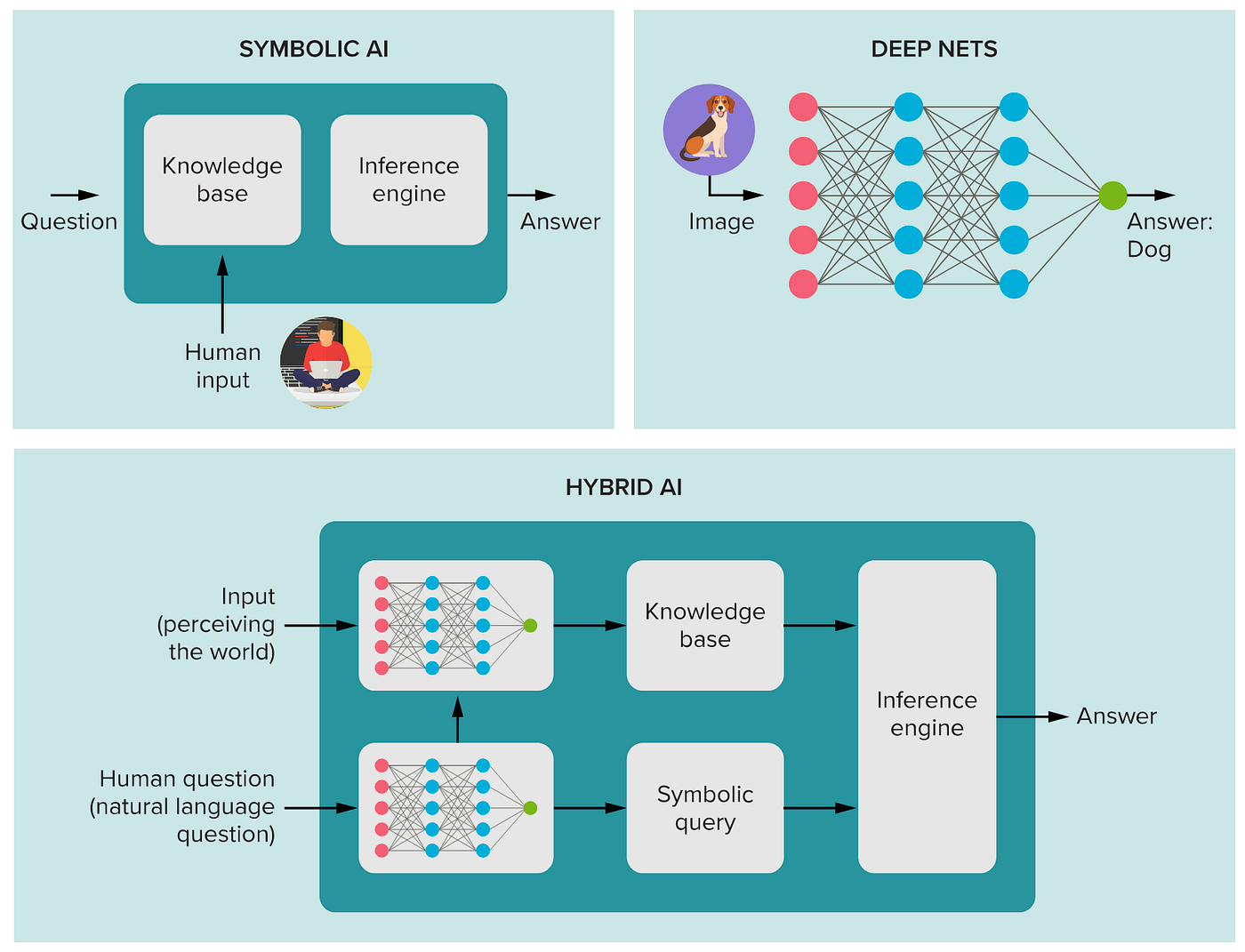
Historically, the field of AI was largely defined by symbolic AI, which could be likened to the "monocled homunculus in a castle of code." This traditional paradigm relied on explicit rules, logical reasoning, and predefined knowledge bases, excelling in structured environments and offering transparent decision-making. However, symbolic systems often struggled with ambiguity, the processing of vast amounts of unstructured data, and the "brittleness" of manually encoded knowledge, limiting their scalability and adaptability.
The subsequent emergence of neural networks and deep learning introduced a contrasting paradigm, aligning with the tweet's vision of "planting a forest of paraconsistent gametrees in the compost of our collective psyche." These systems learn intricate patterns from immense datasets, or the "collective psyche," leading to breakthroughs in areas such as image recognition, speech processing, and natural language understanding. Neural networks are adept at handling messy, "paraconsistent" real-world data, though their internal decision-making processes often remain opaque "black boxes."
Current research is increasingly focusing on neuro-symbolic AI, a hybrid approach that aims to combine the strengths of both traditional symbolic reasoning and modern neural networks. This integration seeks to leverage neural networks' powerful pattern recognition capabilities with symbolic AI's logical precision and inherent interpretability. According to a study in Neural Computing and Applications, this approach is particularly powerful for complex tasks requiring both pattern recognition and logical reasoning.
Neuro-symbolic systems offer the promise of more robust, explainable, and human-like AI. Applications are emerging across various sectors, including healthcare for diagnostics, autonomous systems for decision-making, and financial services for fraud detection and risk assessment. By providing transparent reasoning alongside adaptive learning, these hybrid models address critical limitations faced by purely neural or symbolic systems.
This ongoing evolution signifies a critical turning point in the pursuit of more general and adaptable artificial intelligence. By moving beyond singular approaches, the AI community is fostering systems that can both learn from vast, complex data and apply structured, logical reasoning. This integration promises to unlock new possibilities for AI applications across diverse domains, ultimately contributing to more trustworthy and capable AI.